Asian banks: already in Europe, not yet in its crypto market
Five Asian groups hold a MiCAR authorisation, none of them through a bank. This guide maps who is already in, who is not yet, and four routes into 30 European markets.
 Get the guide
 Study by CheckSig, the first MiCAR-authorised crypto
operator in Italy
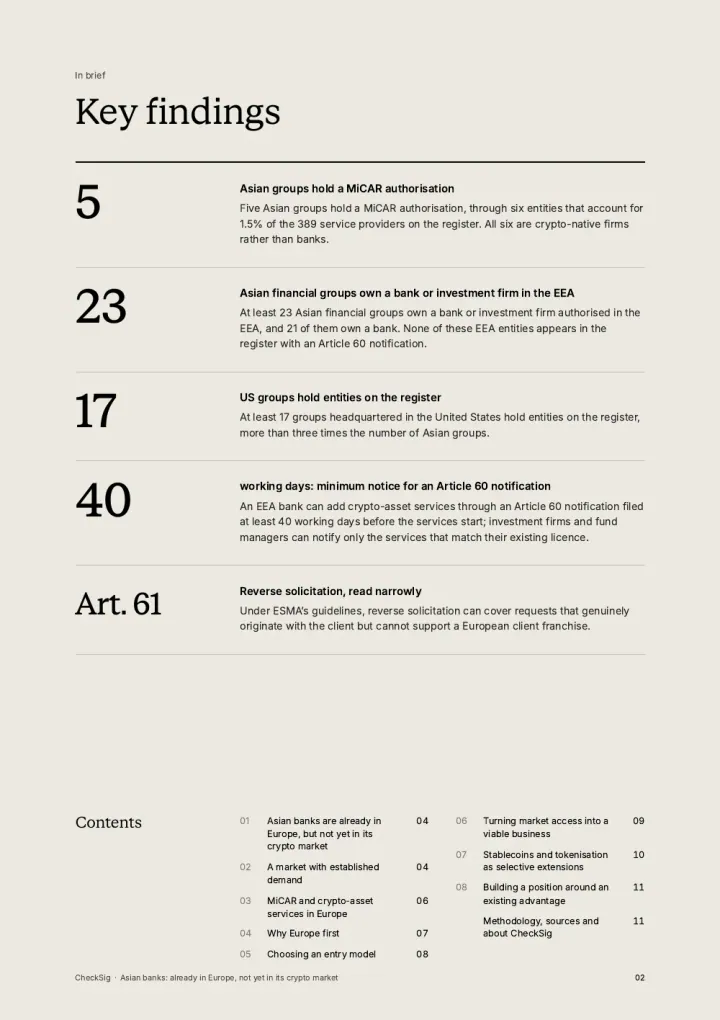
Key findings
Europe is open. Asian banks are not yet in.
The absence of Asian banks does not reflect a lack of European presence.
Sources: ESMA interim MiCAR register (CASPS.csv), version of 30 October 2026; ECB lists of supervised entities and monetary financial institutions; CheckSig analysis.
5
Asian groups with a MiCAR authorisation
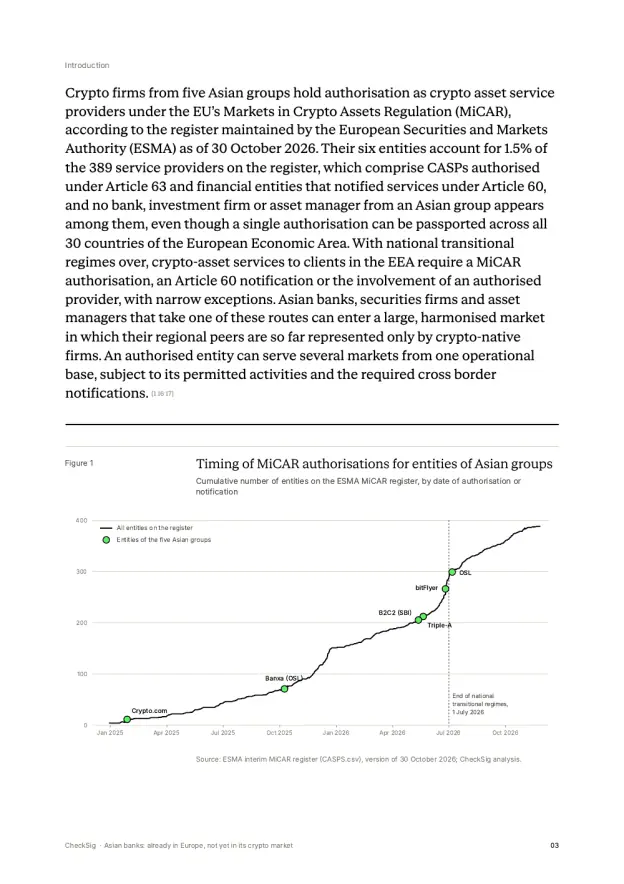
Six entities, 1.5% of the 389 service providers on the ESMA register. All six are crypto-native firms rather than banks.
23
Asian groups already in the EEA
At least 23 Asian financial groups own a bank or investment firm authorised in the EEA. None appears in the register with an Article 60 notification.
17
US groups on the register
At least 17 groups headquartered in the United States hold entities on the register, more than three times the number of Asian groups.
Entry models
Four routes into 30 European markets

New specialist subsidiary
Authorisation as a CASP from the competent authority of its home Member State (Article 59). The subsidiary provides the services.

Existing EEA bank or investment firm
Notification under Article 60, within the scope of the entity’s existing licence, at least 40 working days before the services start.

Partnership with an authorised provider
No MiCAR permission for the group, provided its actual role, including any reception of orders or advice, stays outside regulated crypto-asset services in the EEA.

Acquisition of an authorised provider
The target keeps its authorisation, subject to the competent authority’s assessment of the acquisition (Article 83).
Why Europe first
One authorisation, 30 national markets
Europe is the only jurisdiction where a single authorisation covers crypto-asset trading, custody and transfer services across 30 national markets.
The United States has a federal framework for payment stablecoins but not yet for trading and custody, and the main Asian financial centres regulate these activities for their domestic markets.
Entities on the register
389
Countries covered by one passport
30 in the EEA
Article 60 notice
40 working days
Services under MiCAR
10, chosen to fit the business
Free guide
The full analysis, in 14 pages
Register data, entry models, prudential requirements and where stablecoins and tokenisation fit. Fill in the form and we send the guide to your inbox.

Frequently asked questions
What institutions ask first
Yes, through an Article 60 notification. A bank can notify any crypto-asset service; investment firms and fund managers can notify only the services that match their existing licence. The notification must be filed at least 40 working days before the services start.
No. An Asian domestic licence alone provides no European entitlement. Crypto-asset services to clients in the EEA require a MiCAR authorisation, an Article 60 notification or the involvement of an authorised provider, with narrow exceptions.
Only for requests that genuinely originate with the client. Under ESMA’s guidelines, general brand advertising, social media, sponsorship of European events and content targeted at European audiences can each count as solicitation. Reverse solicitation cannot support a European client franchise.
From the interim MiCAR register published by ESMA, in the version available on 30 October 2026: 389 distinct entities after merging duplicate rows. The guide sets out the full methodology and its limits.
Ready to read it? Get the guide by email